Phonics

At Raysfield, we use Read Write Inc. Phonics which is a DfE-validated systematic synthetic phonics programme with a whole school approach to teaching early reading and writing. RWI was developed by Ruth Miskin and more information on this can be found at https://ruthmiskin.com/en/find-out-more/parents/.

The programme is designed for children aged 4-7. However, at Raysfield we begin the programme in Reception and will continue teaching RWI to children beyond the age of 7 if they still need support in their reading. This is either through Read Write Inc. lessons, Fast Track tuition or Fresh Start tuition programmes.

Miss Calver is our Reading lead teacher, so if you have questions about phonics or reading, please contact school who can refer you to her. Please take the time to read the information as it will provide invaluable information as to how you can help and support your child in reading.

How is Read Write Inc. taught?

All children are assessed regularly by our RWI lead teacher so they work with children at the same level. This allows complete participation in lessons and access to reading books at the correct reading level.

Reception
We start by teaching phonics to the children in Reception which means that they learn how to ‘read’ the sounds in words and how those sounds can be written down. This is essential for reading, but it also helps children learn to spell well. We teach the children simple ways of remembering these sounds and letters. See our handwriting rhymes at the bottom of the page.

Year One & Year Two
Children follow the same format as Reception but will work on complex sounds and read books appropriate to their reading level. Daily sessions of RWI phonics last for one hour. Once children become fluent speedy readers they will move onto the RWI comprehension and language group during phonics time. This follows a similar structure but has children will read longer texts with a focus on comprehension and grammar.

Children will be taught to read by:

Reading:

The children:

  • learn 44 sounds and the corresponding letters/letter groups using simple picture prompts – see below
  • learn to read words using Fred talk and sound blending
  • read from a range of storybooks and non-fictions books matched to their phonic knowledge
  • work well with partners
  • develop comprehension skills in stories by answering ‘Find It’ and ‘Prove It’ discussion questions

Writing

The children:

  • learn to write and form the letters/letter groups which represent the 44 sounds with the help of fun phrases
  • learn to write words by using Fred Talk
  • learn to build sentences by practising sentences out loud before they write 

Talking

The children:

  • work in pairs so that they:
    • answer every question
    • practise every activity with their partner
    • take turns in talking and reading to each other
    • develop ambitious vocabulary

Have you heard about Fred?

When we teach sounds we use pure sounds (‘m’ not’ muh’,’s’ not ‘suh’, etc.) so that your child will be able to blend the sounds into words more easily.

At school we use a puppet called Fred who is an expert on sounding out words! We call it, ‘Fred Talk’. E.g. m-o-p, c-a-t, m-a-n, sh-o-p, b-l-a-ck.

The video is an example of blending sounds with Fred. 

Taught sounds:

Children are taught the sounds in three sets.

Set 1

Set 1 Sounds are taught in the following order together with rhymes to help children form the letters correctly and instantly recognise sounds ready for blending. At this stage we do not use the letter names. Use the link below to support your pronunciation of the sounds correctly.

Set 2 and 3

The children are then taught Set 2 Sounds – the long vowels. When they are very confident with all of set 1 and 2 they are taught Set 3 Sounds.

Set 3

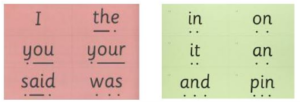
Within all the RWI sessions/books children will be exposed to red and green words to learn to help them to become speedy readers. Red words are words that are not easily decodable and challenge words to extend children’s vocabulary. Green words are linked to the sounds they have been learning and are easily decodable.

Nonsense words (Alien words)

As well as learning to read and blend real words children will have plenty of opportunities to apply their sound recognition skills on reading ‘Nonsense words’. These words will also feature heavily in the Year One Phonics Screening check in the summer term.  These words provide endless opportunities for children to apply and practice their thinking in a range of different contexts. 

To help at home:

Developing readers in Reception will take home RWI phonics books to practise the phonics skills they are learning at school, and a picture book for you to read with your child. Phonics books aid application, speed and fluency- developing speedy reading!  Following on from this, they will bring home a comprehension based book which will begin to enrich their reading. This will require decoding skills. Children will bring home enriched reading books which will enhance their understanding via inspirational language promoting depth to their understanding.

Useful websites for Parents

Please find a list of websites that you may find useful in helping you and your child learn about phonics. Games and fun activity websites are also included.

https://www.ruthmiskin.com/en/find-out-more/parents/ – Information and resources to support phonics learning at home

http://www.bbc.co.uk/bitesize/ks1/literacy/phonics/play/ – fun games for the children to play

http://www.ictgames.com/literacy.html  – fun games for the children to play

http://www.firstschoolyears.com/  – fun games for the children to play

BBC Bitesize – many games to play covering all areas of the curriculum

Scroll to Top